MindSigns Website
Mental health, in sign language.
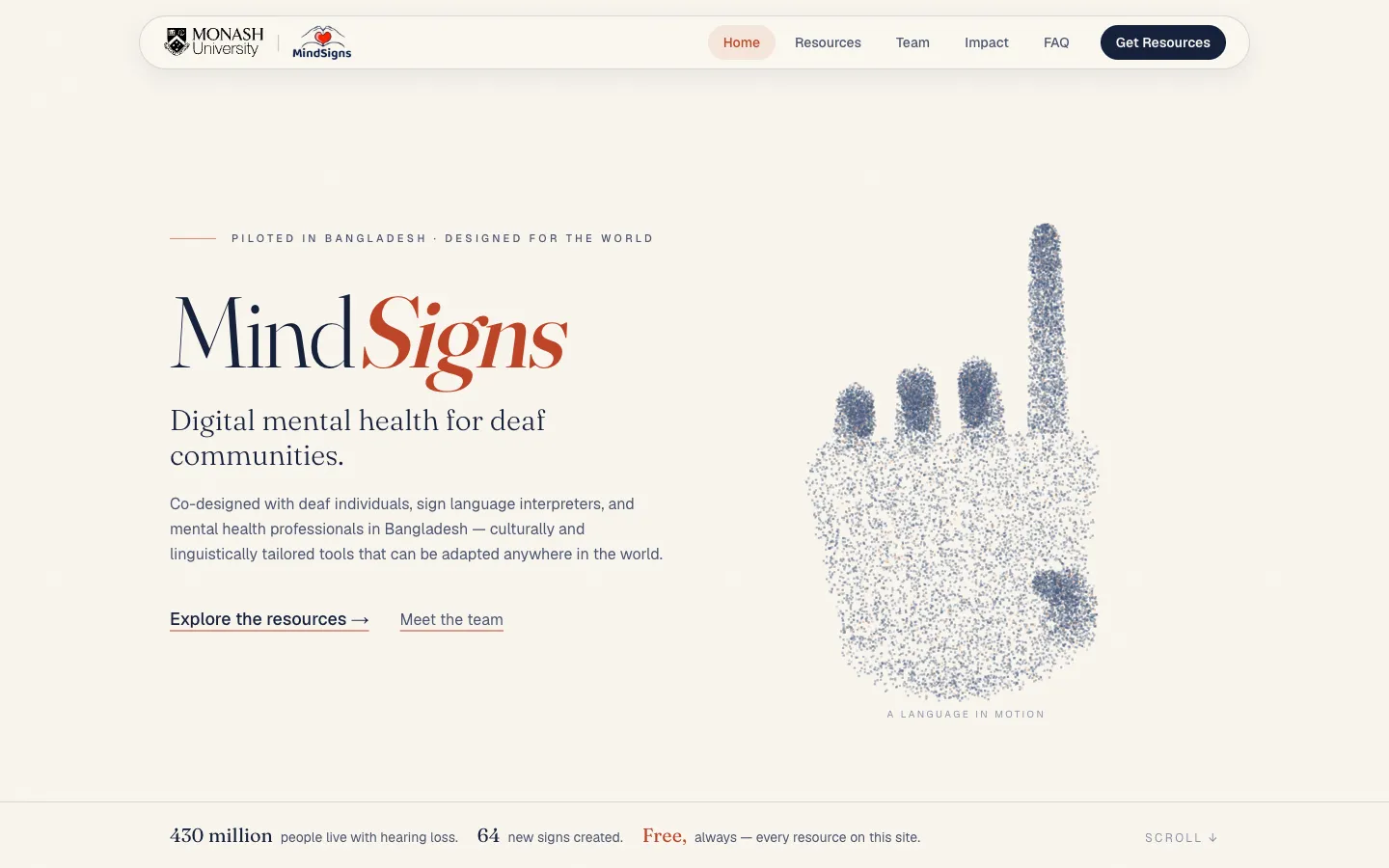
MindSigns is a Monash University Faculty of IT initiative that makes mental health resources for deaf communities, co-designed with deaf people, sign language interpreters and clinicians in Bangladesh. Its website gathers them in one place, all free: a sign language bank, e-flyer packs and videos, introduced by a hand made of particles that signs.
The hand
A hand that signs, made of particles.
18,000 points make up the hand on the home page, with no 3D model behind it: the palm and each finger are described in code. On load, a scattered cloud gathers into the hand, which then moves between an open hand, pointing and the sign for "I love you". Each particle travels to its place in the next pose, so the hand morphs rather than cuts.
- A faint shimmer keeps it alive between poses
- With Reduce Motion on, it skips the entrance and holds one pose
Sign Language Bank
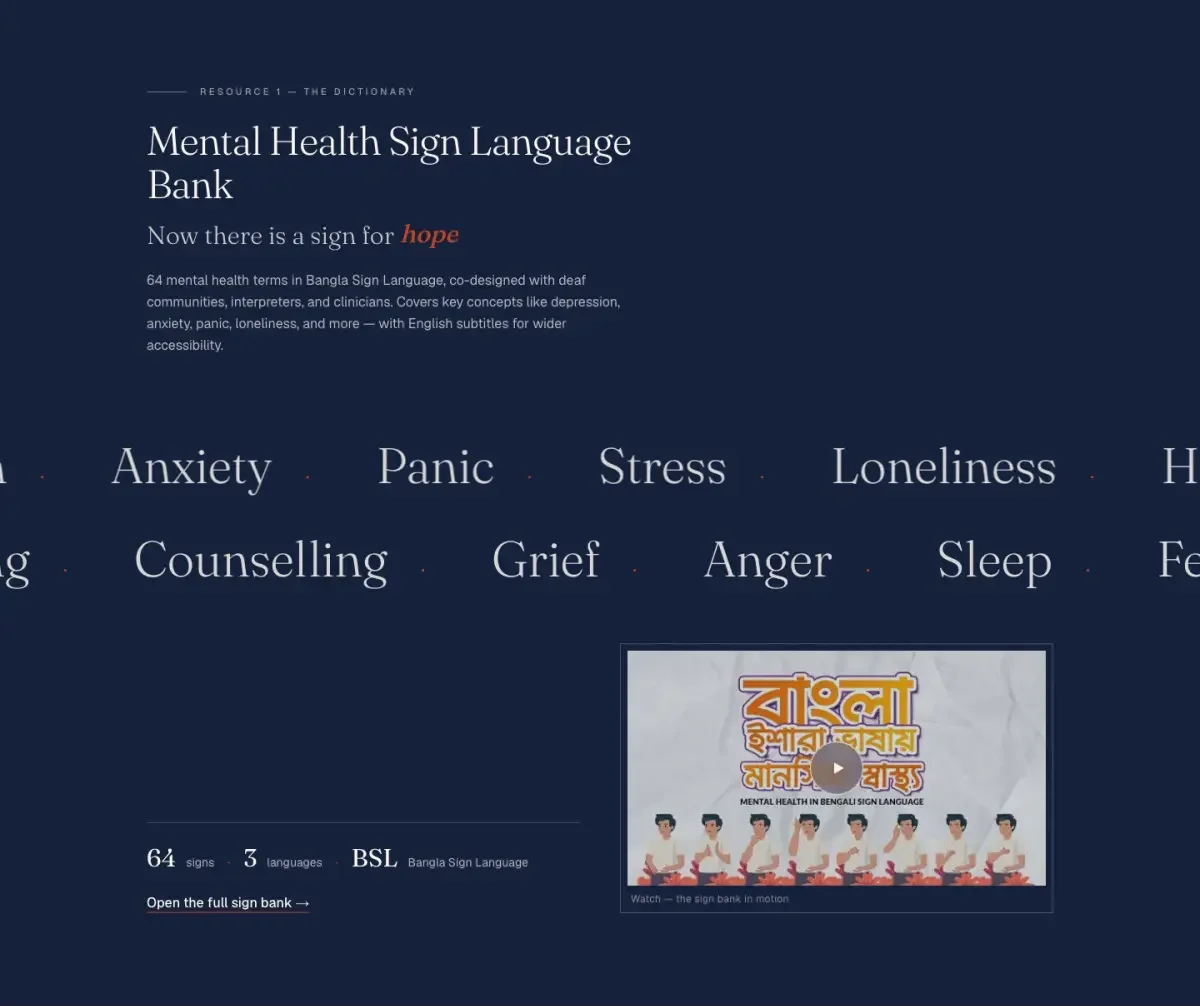
64 mental health terms in Bangla Sign Language.
The project's main resource is a bank of signs for words like anxiety, panic, grief and loneliness, created with the deaf community. On the site the words drift across the page in two rows, and each one links to the bank.
E-flyers
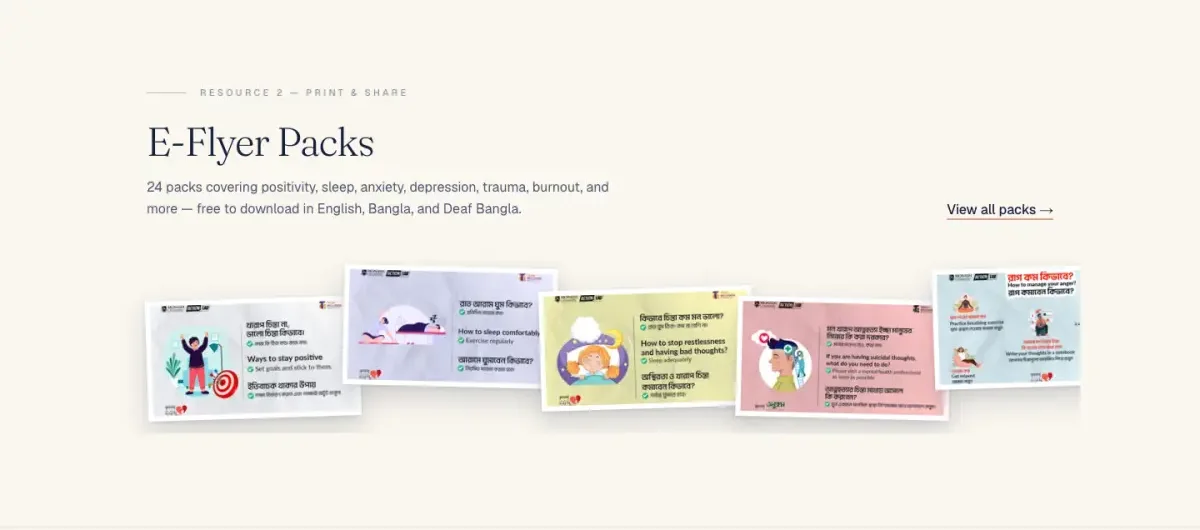
Flyers to print and share, one download each.
25 e-flyer packs cover positivity, sleep, anxiety, depression, trauma, burnout and more, in English, Bangla and Deaf Bangla. Each pack downloads as a single zip, so a pack with ten flyers is still one tap.
Videos and people
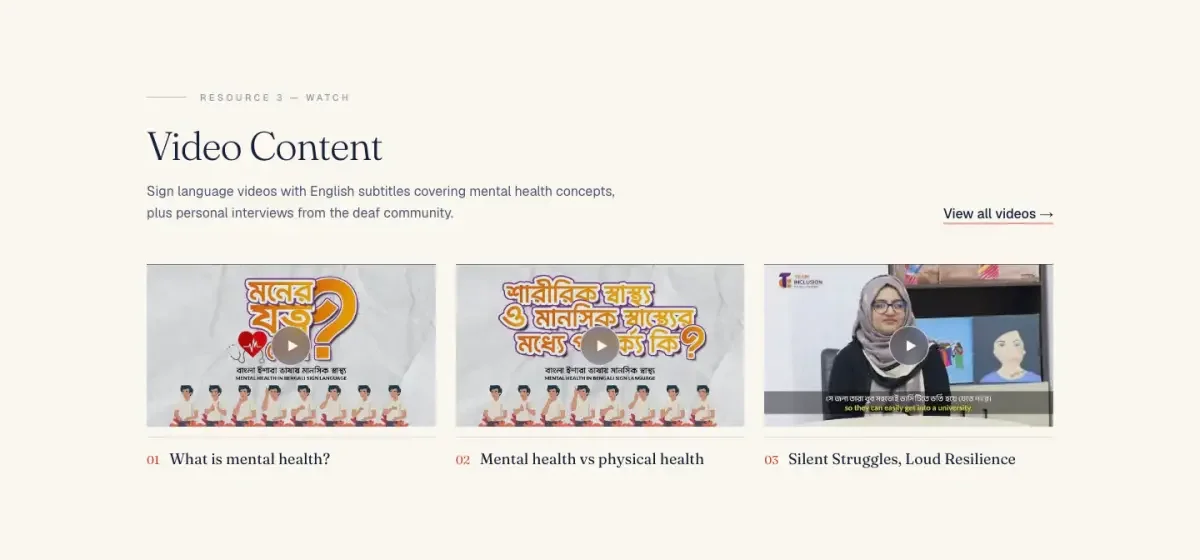
Watch the signs, then meet the people behind them.
Sign language videos with English subtitles explain mental health concepts, alongside interviews with deaf community members, and play inline. Team, Expert Panel and Impact pages introduce the researchers and clinicians, the awards and the media coverage, and an FAQ links to support services.
And the details.
- 18,000particles in the hand, with no model file
- 64signs in the mental health bank
- 25e-flyer packs, free to download
Welcome splash
MindSigns spells itself out on arrival. Tap to skip it.
Editorial look
Fraunces headlines and Geist text in paper, ink and vermillion.
Phones get hover too
Rows light up as they scroll into view on touch screens.
Reduced motion
With Reduce Motion on, the hand holds one pose and the cycling word stops.
One-tap support
Helpline numbers and websites in the FAQ and Resources open with a tap.
Uptime checks
Checkly tests the home page every five minutes from the US and Europe.
How it's built
Next.js, React, TypeScript.
The site is Next.js 16 with React 19, TypeScript and Tailwind CSS 4. The hand is React Three Fiber over Three.js, and Framer Motion runs the reveals and the cycling words. I designed and built the site, and I'm on the MindSigns team as a student researcher.
- Next.js
- React
- TypeScript
- Three.js
- React Three Fiber
- Framer Motion
- Tailwind CSS
A hand from capsules
Points are sampled once along capsule chains for the palm and fingers, with a seeded random generator so the server, the browser and every pose agree. Each pose re-evaluates the same points, which is what makes the morph smooth.
Packs zipped on request
A route handler gathers a pack's flyers into a zip named after it as it's downloaded, so the site keeps only the flyer images and no copies of each pack.
Hover for touch screens
On devices without hover, an IntersectionObserver marks each row as active while it's in view, and matching Tailwind variants sit beside every hover style.